The Pivot Pyramid
A visual framework for startup experimentation. Understand where to pivot and how changes cascade through your business.
Why I Created This Framework
In 2016, after my second startup, I joined 500 Startups as a Venture Partner. Having been through my own journey pivoting Socialwire from a product recommendation engine for online retailers to a product advertising platform, I recognized a familiar struggle in the founders I was working with: deciding what to change when things weren't working.
Some would pivot their entire business when they just needed a new marketing channel. Others would tweak their landing page when the real problem was they were targeting the wrong customers. And some were building for multiple customer profiles with completely different problems—essentially running three startups at once without realizing it. The cost of getting this wrong was huge—wasted months, burned runway, demoralized teams.
I created the Pivot Pyramid to give founders a simple mental model for these decisions. It was first published on the 500 Startups blog and has since been featured in VentureBeat and many other publications online.
The Five Layers
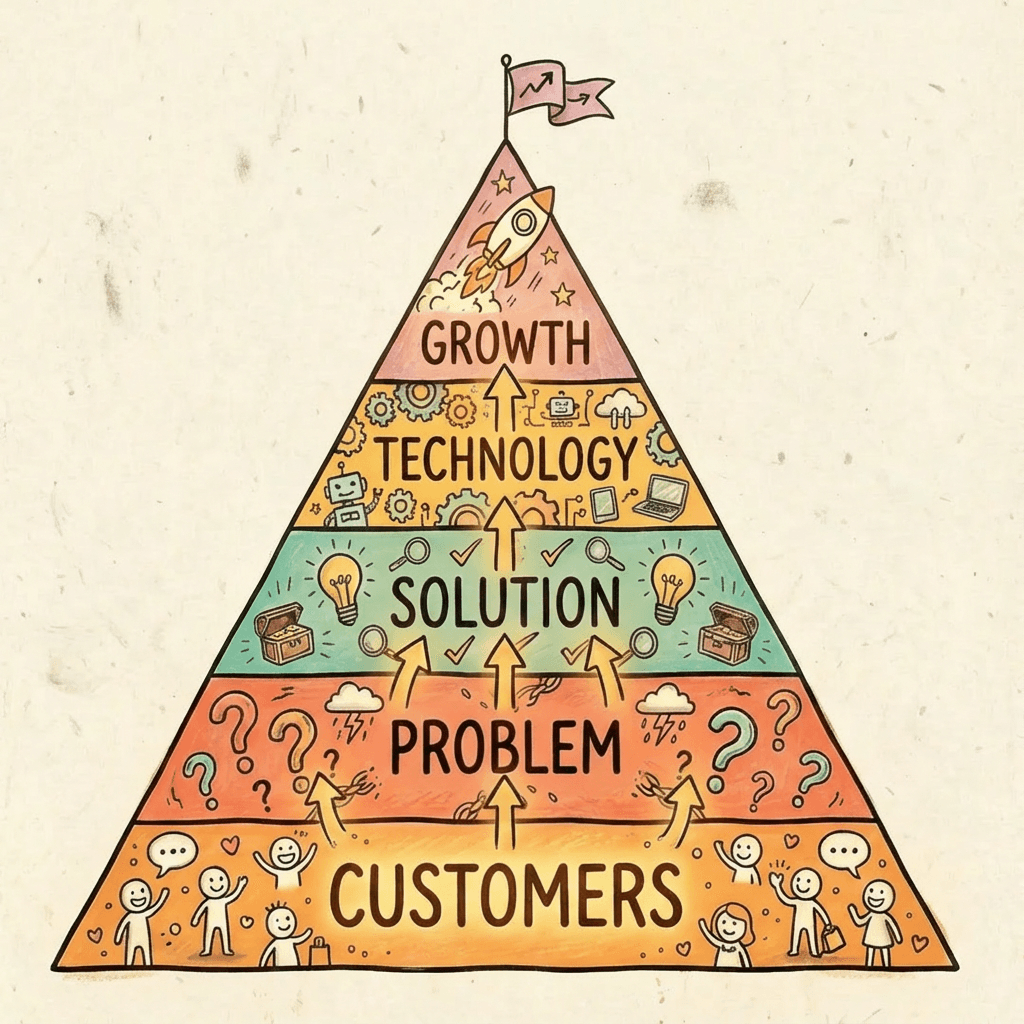
Every startup can be broken down into five layers. Understanding these layers helps you identify where to focus your experiments and what the true cost of change will be.
Customers
Who are you building for? This is the foundation of your startup. Changing your target customer is the most fundamental pivot—it affects everything above it.
“Are you solving a real problem for people who will pay?”
Real-World Pivots:
- →Shopify started selling snowboards online, then pivoted to building tools for anyone selling online
- →Slack started as Glitch, a multiplayer game, before pivoting to team communication
Problem
What pain point are you addressing? If you change the problem you're solving, you need to reconsider your solution, technology, and growth strategy.
“Is this problem painful enough that people actively seek solutions?”
Real-World Pivots:
- →Instagram kept the same young social users but pivoted from check-ins (Burbn) to photo sharing
- →Twitter kept tech-savvy users but pivoted from podcast discovery (Odeo) to microblogging
Solution
How do you solve the problem? This is your product or service. Changing your solution is less disruptive than changing customers or problems.
“Is your solution 10x better than alternatives?”
Real-World Pivots:
- →Netflix solved home entertainment first with DVD-by-mail, then pivoted to streaming
- →Duolingo kept language learners but pivoted from crowdsourced translation to gamified self-study
Technology
What do you build to deliver the solution? Technology changes are relatively easy pivots—you're just changing how you implement your solution.
“Does your tech stack enable or constrain your solution?”
Real-World Pivots:
- →Facebook rewrote from PHP to Hack/HHVM to handle scale—users never noticed
- →Harvey upgraded from GPT-3 to GPT-4—same legal AI product, but suddenly good enough for elite law firms
Growth
How do you acquire and retain users? This is the easiest layer to pivot—changing your marketing channels or growth tactics doesn't affect your core product.
“What's your unfair advantage in acquiring customers?”
Real-World Pivots:
- →Airbnb auto-posted listings to Craigslist for distribution—no product or tech changes needed
- →Dropbox's referral program drove viral growth without changing the core product
The Core Insight
The lower in the pyramid you pivot, the more fundamental the change.
When you change something at the bottom of the pyramid (like your target customers), everything above it needs to change too. But when you pivot at the top (like your growth channels), the layers below remain stable.
This framework helps founders make informed decisions about where to experiment and understand the true cost of different types of pivots.
Key Takeaways
Start with customer and problem
Y Combinator's “Make Something People Want” maps to the bottom three layers. Talk to customers to validate them—conversations reveal which layer needs to change.
Pivoting below changes everything above
Changes at the bottom of the pyramid impact all layers above. Changes at the top don't require changes below. Your pace of experimentation should increase toward the top.
Focus on one customer type
Targeting different customer types = building multiple startups at once. Only mature businesses can successfully expand into multiple customer segments—Shopify focused exclusively on small merchants before adding enterprise years later.
How to Use the Pivot Pyramid
Identify Your Current State
Map your startup onto the pyramid. Be clear about who your customers are, what problem you solve, and how you solve it.
Diagnose the Issue
When something isn't working, identify which layer is broken. Don't change your growth strategy if the real problem is your target customer.
Understand the Cascade
Before pivoting, understand what else needs to change. A customer pivot means reconsidering everything above it.
Experiment Strategically
Start experiments at the top of the pyramid where changes are cheaper. Only pivot lower layers when you have strong evidence.
Coming Soon
Get the Complete Guide
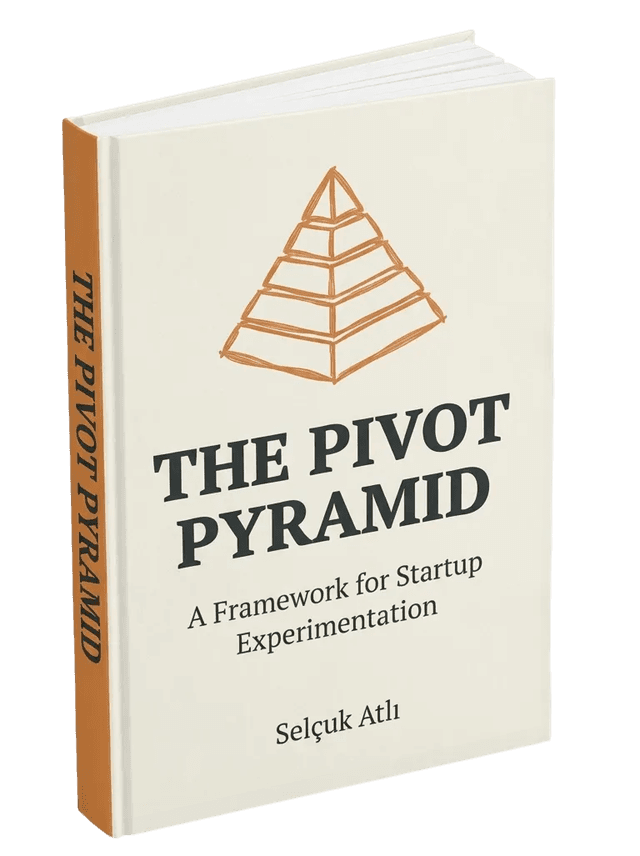
The Pivot Pyramid Ebook includes detailed examples, worksheets, and exercises to help you systematically experiment with your startup.
Start Using the Framework
Document your startup hypotheses with our AI-powered canvas. Get guidance on where to pivot and how changes cascade through your business.
Open Pivot Canvas
About the Author
Selçuk Atlı
I'm a serial entrepreneur, investor, and songwriter based in New York. Most recently, I founded Bunch, a group video chat app for playing games together, used by over 10 million players. Before that, I founded and sold two adtech companies: Manifest (acquired by Rakuten) and Boostable (acquired by Metric Collective).
I conceptualized the Pivot Pyramid while serving as a Venture Partner at 500 Startups, where I worked with dozens of early-stage founders navigating the search for product-market fit.
Learn more about me